Consultant Presentation Packets
View the data presented by SME Consulting and 1961 Consulting to City Council about the Municipal Urban Growth Areas below.
Frequently Asked Questions
What is being proposed?
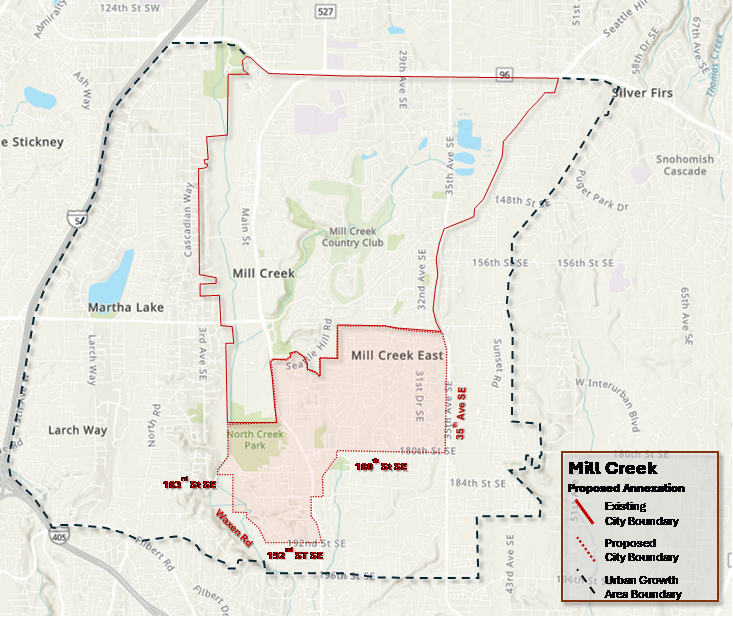
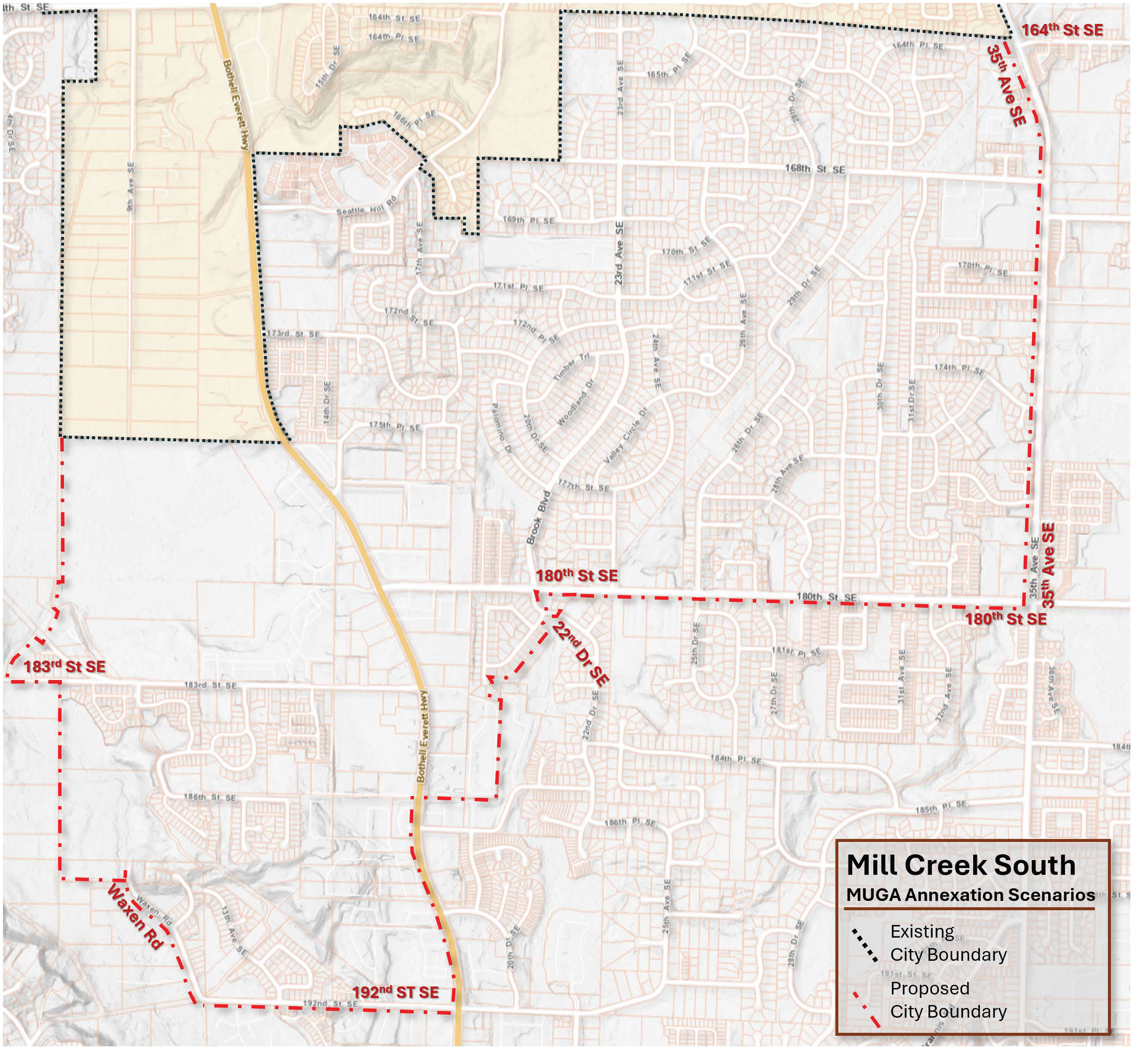
Mill Creek is discussing annexing a portion of its Urban Growth Area south of the city. The physical boundaries are 35th Avenue down to 180th, following 22nd Dr SE to 192nd St SE, up Waxen Rd to 183rd St SE into Mill Creek. View the boundary map here.
Isn’t this area already part of Mill Creek?
No, the properties are in unincorporated Snohomish County. However, it is part of Mill Creek’s Urban Growth Area.
Why is the City doing this?
The Growth Management Act of 1990 expects cities – not counties – to serve urban areas to prevent sprawl, protect the environment, and deliver services more cost-effectively as communities grow. Annexing this area aligns with that expectation.
What will change for residents in the annexation area?
The City will receive property taxes from the area instead of the county. All residents will come to the Mill Creek City Hall for services they require. In addition, they will have elected representation through the seven-member Mill Creek City Council.
What will change for property owners and residents already in the city?
Short-term, revenue from additional properties will maintain city service levels reducing the need for higher taxes. Long-term, annexation will spread the cost of large-scale capital projects over more people, reducing an individual’s tax burden.
Will property owners have to join an HOA?
No, property owners do not have to join a homeowner’s association.
Why this area specifically?
The area already reflects the current feel and nature of the city. Many residents also shop, work, attend schools, use city roads, and recreate in city parks.
Why annex this area now?
This is not a sudden decision. This area has been in the city’s UGA for 34 years and is part of the short-term priorities in Council’s 2040 visioning document passed in 2024.
How many people live in this area?
Approximately 11,000.
How many people live in the city’s UGA?
Approximately 54,000
Why not just annex the whole UGA?
Annexations must be carefully planned to ensure the city is able to provide services and infrastructure investments to an area. Careful analysis has gone into determining that this is the right size of an area and population to ensure continuity and improvements to service.
Will residents have an opportunity to vote on annexation?
The City Council has not yet selected an annexation method and is expected to discuss and determine its next steps at its December 1 meeting. If the City pursues annexation through an Interlocal Agreement (ILA) with Snohomish County, annexation would not require a public vote. However, residents would continue to have meaningful opportunities to participate through public meetings, hearings, written comments, community outreach, and communication with elected officials throughout the process. The ILA process replaces a single election with multiple opportunities for public participation and feedback before any final decisions are made.
Regardless of the selected process, residents will continue to have opportunities to learn more, ask questions, and share their perspectives before a final annexation decision is made. If annexed, residents would gain representation on the Mill Creek City Council and the ability to vote in City elections.
Residents who would like to share their thoughts about the annexation process with Snohomish County may also contact Snohomish County Councilmember Jared Mead, District 4, at jared.mead@snoco.org.
Are my taxes going up, and what will I pay compared to today?
City taxes would apply after annexation. However, based on current estimates, the overall financial impact for most households would be approximately a wash. For more information on taxes in Mill Creek check out our Town Hall Materials.
Property owners in the area will see a property tax decrease when they go from the county to the city from $9.26 to $8.73 per $1,000 of assessed property value. (For a home valued at $850,000 the difference is approximately $250 less per year.)
In general, Mill Creek's lower property tax rate is expected to offset the City's utility tax. The exact impact on your household would depend on factors such as your property's assessed value, utility usage, and individual circumstances.
What are the actual benefits of annexation for residents?
Residents in the annexation area would receive services directly from the City of Mill Creek, including police service from the Mill Creek Police Department rather than the Snohomish County Sheriff's Office.
Potential benefits include:
- More local police presence and faster access to City public safety resources.
- Enhanced public works services, including more frequent street sweeping, roadway maintenance, pavement preservation, traffic sign maintenance, and responsiveness to neighborhood concerns.
- Local decision-making and representation through the Mill Creek City Council, giving residents a stronger voice in decisions affecting their community.
- Improved coordination of transportation, parks, infrastructure, and future development by having one local government responsible for planning and service delivery.
- Greater influence over community character and growth, as residents can participate directly in City planning and policy discussions.
- A broader tax base to help support municipal services and infrastructure investments, helping distribute costs across a larger population.
Beyond governance, annexation is fundamentally about receiving City services from the community where residents live, work, shop, and recreate. The goal is to provide responsive local services, maintain community infrastructure, enhance public safety, and preserve the high quality of life that residents expect from Mill Creek.
What is the timeline, what phases are involved, and when could annexation take effect?
The annexation proposal is currently in the review and public outreach phase. The City Council is expected to discuss and determine its next steps for annexation at its December 1, 2026 meeting.
If the Council decides to continue pursuing annexation, the process would generally include:
- Public Outreach & Community Engagement – Opportunities for residents to learn about the proposal, ask questions, and provide feedback.
- Formal Annexation Process – Public hearings, negotiations with Snohomish County, and consideration of any required agreements or ordinances.
- Final Approval – Adoption of the necessary annexation actions by the City and County.
- Implementation & Transition – Planning for service delivery, governance, budgeting, and operational changes to ensure a smooth transition.
The timeline will depend on the annexation method selected and the statutory requirements associated with that process. If the Council elects to move forward, annexation would not take effect immediately and would require completion of several additional steps before becoming effective.
Regardless of the selected process, residents will continue to have opportunities to learn more, ask questions, and share their perspectives before any final annexation decision is made. Additional information and timelines will be shared as decisions are made.
Will I have to pay City taxes, County taxes, or both?
Residents would continue to pay applicable county, state, and other regional taxes that apply throughout Snohomish County.
Following annexation, City taxes and fees would also apply while certain County service-related taxes may no longer apply. The exact combination of taxes depends on the specific tax type.
Annexation is intended to align taxes with the local services residents receive. In return, residents would receive City services such as police protection, street maintenance, street sweeping, transportation improvements, traffic sign maintenance, and other municipal services provided directly by the City of Mill Creek.
While individual impacts will vary, current estimates indicate that for many households the overall financial impact may be relatively modest, with changes in taxes helping support the enhanced local services and representation that come with being part of the City. Current estimates indicate that increases and decreases in taxes and fees would largely offset one another for many households.
How will annexation affect property taxes, utility taxes, sales taxes, car tabs, RTA/PTBA taxes, and other fees?
Different taxes and fees are affected differently by annexation, and the overall impact will vary by household.
Generally:
- Property taxes are expected to decrease. The current County levy rate is approximately $9.26 per $1,000 of assessed value, compared to the City's levy rate of approximately $8.73 per $1,000.
- A 5% City utility tax would apply.
- State sales tax rates would not change due to annexation.
- Both County and City residents are expected to pay the same $20 Transportation Benefit District vehicle fee beginning in 2027.
- Regional taxes and fees, such as Sound Transit (RTA) and transit-related charges, are established by separate agencies and generally are not affected by annexation.
For example, a home with an assessed value of $850,000 would see an estimated property tax reduction of approximately $250 per year based on current levy rates.
While individual circumstances vary, current estimates indicate that many residents would experience a relatively modest overall financial impact while receiving City services directly from Mill Creek, including police, street maintenance, street sweeping, transportation planning, and other municipal services.
The City will continue to provide tax comparison information and financial analysis as the annexation process moves forward.
Can the City maintain current service levels, staffing, and infrastructure after annexation?
Yes. Based on the City's financial and operational analysis, annexation is being considered because the City can continue providing high-quality services while successfully serving the annexation area.
If annexation moves forward, the City would add the staffing, equipment, and resources necessary to serve the expanded community. Planning and financial projections have been developed to ensure police, public works, parks, and other municipal services can be maintained and supported over the long term.
In fact, annexation is expected to strengthen the City's ability to provide local services by expanding the population and tax base that supports them. Residents in the annexation area would benefit from direct City services, including police protection, street maintenance, street sweeping, transportation improvements, traffic sign maintenance, and other municipal services provided by the City of Mill Creek.
The City's goal is not simply to maintain existing service levels, but to ensure residents continue to receive responsive, high-quality local services while preserving the City's long-term fiscal sustainability.
How will stormwater facilities, retention ponds, catch basins, and surface water systems be maintained after annexation?
Responsibility for stormwater infrastructure depends on the ownership and function of each facility.
Public stormwater facilities that become part of the City's system would generally be maintained by the City. Privately owned facilities, including some neighborhood pond and drainage systems, will remain the responsibility of the property owner, HOA, or other private entity.
As annexation planning continues, the City will work to identify ownership and maintenance responsibilities for specific facilities throughout the annexation area.
What Mill Creek codes and regulations will apply to my property after annexation?
If annexation occurs, properties within the annexation area would generally be subject to the same City of Mill Creek codes and regulations that apply to other Mill Creek residents today. These existing regulations address topics such as land use, building standards, setbacks, permits, signage, landscaping, parking, and future development.
Annexation would not automatically change property zoning or existing neighborhood character. Any future zoning or land use changes would require public notice, public hearings, and opportunities for community input before decisions are made.
Residents will have opportunities throughout the annexation process and future City planning efforts to provide feedback and help shape how their neighborhoods and community grow over time. For questions about a specific property, residents are encouraged to contact City staff.
Can I continue to park RVs, trailers, boats, commercial vehicles, and other equipment on my property?
If annexation occurs, current City of Mill Creek parking regulations would apply within the annexation area. These regulations vary depending on the type of vehicle and whether it is parked on private property or within the public right-of-way. In general, vehicles displaying business logos are not regulated solely because they display a logo. The City's code is primarily focused on larger commercial vehicles, such as semi-trucks.
Residents should also know that annexation would not immediately change existing zoning or development regulations within their neighborhoods. The annexation process includes public hearings and opportunities for community input, and residents can participate in future land use and zoning discussions through the City's public review processes. These opportunities allow residents to help shape how their community grows and develops over time.
Because regulations vary based on specific circumstances, residents are encouraged to contact City staff regarding particular vehicles, equipment, or parking situations.
Will existing property uses, including home businesses, ADUs, fences, animal husbandry, and garages, be allowed to continue after annexation?
In many situations, existing legally established uses may continue after annexation even if City regulations differ from County regulations.
Examples could include certain agricultural uses, animal husbandry activities, structures, or other property uses that were legally established before annexation. Future changes, expansions, or redevelopment may be subject to City regulations.
For ADUs, both Snohomish County and Mill Creek generally allow up to two ADUs per lot, though development standards differ. Residents with unique circumstances should contact City staff for property-specific information.
Any formal determination regarding previously conforming uses would be made through future City processes and Council decisions where applicable.
Will my address, mailing address, post office designation, school district, or community identity change?
Annexation would not automatically change your street address or school district boundaries. However, if annexation occurs, the city designation used in your mailing address would likely change to Mill Creek, reflecting that the property is now located within the City.
ZIP codes and postal designations are determined by the United States Postal Service (USPS), not by the City. As a result, any changes to mailing addresses or postal designations would be determined by USPS and may not occur immediately.
Many residents already identify as part of the Mill Creek community through shared schools, parks, trails, shopping areas, and community events. The proposed annexation area has been within Mill Creek's Urban Growth Area (UGA) for more than 30 years and has long been included in the City's long-range planning efforts.
Annexation would primarily change which local government provides services and representation, rather than the community connections residents experience in their daily lives.
How will roads, sidewalks, street lighting, traffic signals, street signs, and future transportation projects be managed?
This means residents would receive transportation and public works services directly from the City, including street maintenance, pavement preservation, street sweeping, traffic sign maintenance, sidewalk repairs, street lighting maintenance, and other transportation-related services.
The City would plan, maintain, and prioritize transportation improvements through its Capital Improvement Program and long-range planning processes.
This would allow transportation projects to be coordinated with public safety, utilities, parks, development, and other community investments to better serve local residents. Annexation also provides residents with greater local input into future transportation priorities.
Through public meetings, hearings, and the City's planning processes, residents would have opportunities to help shape decisions regarding road improvements, pedestrian connectivity, traffic safety, and other transportation investments in their community.
How much will annexation cost the City, how will it be funded, and what are the long-term financial projections?
The City is evaluating both the short-term and long-term financial impacts of annexation. The analysis considers projected revenues, service costs, infrastructure obligations, staffing needs, and future growth. Annexation would expand the City's tax base, helping distribute service costs across a larger population and supporting the City's long-term financial sustainability.
The City Council will continue reviewing financial information before making any future annexation decisions. Community members can explore the 2027-2052 annexation fiscal projections, and other financial analyses under Consultant Presentation Packets on this page, select the February 3 and February 24 presentations for detailed financial information and assumptions used in the analysis.
How will public input be collected, considered, and incorporated into the annexation decision?
Public participation is an important part of the annexation process, and residents will have multiple opportunities to learn about the proposal, ask questions, and provide feedback before any final decisions are made.
Residents can participate by:
- Attending public meetings and town halls either in person, online, or watching live on YouTube. For information visit our City Council page and look for Council Meeting links.
- Contacting City staff with questions or comments at communications@millcreekwa.gov.
- Providing public testimony at City Council meetings.
- Submitting written comments to the City at cityclerk@millcreekwa.gov.
- Signing up for the City newsletter, Keeping up with the Creek!
- Sharing feedback with Snohomish County officials, including County Councilmember Jared Mead, District 4.
Feedback received through meetings, public testimony, written comments, community outreach, and other engagement efforts is provided to decisionmakers and helps inform City Council and County discussions regarding annexation. Whether residents will also have an opportunity to participate through a formal annexation vote depends on the process selected by the Council. Under the Interlocal Agreement (ILA) process, public participation occurs through ongoing engagement, public hearings, and elected representatives rather than a direct annexation election.
The question is not whether residents have a voice, but how that voice is exercised. Regardless of the annexation process selected, residents will continue to have opportunities to participate, provide input, and help shape decisions affecting their community before any final annexation decision is made.
Questions and Feedback
Fill out the form below to leave feedback or further questions.
Residents who would like to share their thoughts about the annexation process with Snohomish County may also contact Snohomish County Councilmember Jared Mead, District 4, at jared.mead@snoco.org.